From it’s beginnings as St. Marks Anglican Church to it’s present location in the heart of Emsdale, the Anglican Parish of the Good Shepherd has been serving the Emsdale community for almost 150 years.
The church prides itself on the friendly, welcoming atmosphere provided to all newcomers & visitors. Not just a place of worship, from our regular Sunday morning services to our Thursday morning coffee drop-in, Friday morning Bible study & other assorted events, everyone is always welcome to join us.
The History of St. Mark's Anglican Church
Emsdale Ontario
St. Mark's Church is part of the Emsdale Sprucedale Anglican Mission which consists of:
- St. Mark's Emsdale
- St. Pali's Sprucedale
- St. Luke's Kearney
- St. Mary's Novar
These churches have year-round services.
- St. Mary's Sand Lake
- St. Stephen's Broadbent
- St. Olaf's Bear Lake
Have summer services only.
This Mission belongs to the Deanery of Muskoka which is part of the Diocese of Algoma.
The other Deaneries of the Diocese are Algoma, Sudbury, Temiskaming, and Thunder Bay.
The Diocese of Algoma extends from Lake Kipigon and the head of Lake Superior in the west, to the town of Gravenhurst in the east, and from Manitoliin Island in the south to the Temiskaming region in the north. An area in all of about 70,000 square miles, as large as England and Wales together.
What an enormous task it is for the Bishop to visit all the parishes, to know all the priests and the needs of their parishes, holding confirmation, etc. services.
The name Algoma is derived from "Al," an abbreviation of Algonquin, and "Goma," the Indian name for sea. The Indians called Lake Superior the sea of the Algonquins, hence the district in the locality contiguous to the largest body of fresh water on earth was called Algoma.
Salit Ste. Marie is the home of the Diocesan Synod Office and St. Luke's Cathedral.
The See House, the Bishop's home, is in Salit Ste. Marie and is named Bishophurst.
Going back in church time, our history begins with the visit of John Cabot who in 1497 sailed from England and landed on the shores of Canada.
On the spotwheere Cabot and his crew bearing the St. George’s Cross of Merrie Engand the other being that the “St. Mark” the parton of his own dear Venice. The England Charghman first set foot on Canadian soil.
Nearly one hundred years later we find record of the first clergyman, the first sermon and the first celebration of Holy Communion in Canada. One of the expeditions under Sir Martin Frobisher carried a chaplain. On several occasions landing parties accended the highest hill and made crosses of stone in token that ohristians had been there.
Later Master Wolfall on Baffin Island preached a Godly sermon and afterward celebrated a communion around 1578. This was the first time that a Holy Communion was celebrated in Canada and it was conducted by a priest of the Anglican Church. The begining of regular Anglican Church services took place at Port Royal, later to be remamed Annapolis Royal in Nova Scotia.
Englands church came with the British troops to minister to their needs. The first settled clergyman was the Rev. John Harrison as chaplain at Annapolis Royal. In addition to supplying the spiritual wants of the garrison he also ministered to the other people who were attached to the church. The oldest Anglican Church in Canada is St. Pali's Church in Halifax. It was erected in 1750. The first rector was Rev. John Breynton. In 1783 the Rev. Breynton founded a Sunday the world. School, it is the oldest in Canada and one of the oldest in The Diocese of Nova Scotia was formed in 1787, Bishop Inglie was Canada's first bishop. The Diocese of Quebec was then formed in 1793, and the Diocese of Toronto in 1839 as the church spread across Canada.
The Diocese of Algoma is the daughter of the Diocese of Totonto. At First the Diocese or Toronto included all the civil province of Ontario lying south of the hight of land. Out of this large district were carved four other diocese. Diocese of Huron in 1859, Diocese of Ontario in 1861, Diocese of Algoma in 1873 and the Diocese of Niagara in 1875. of these divisions, Huron, Ontario and Niagara having endowed rectories within their limits became at once self sustaining diocese.
The Diocese of Algoma having none had to be a Missionary Diocase altogether dependant for her support upon the church of eastern Canada which had formed her. When that support sholid prove insufficient as was soon the case it had to look for help wherever it was to be found. That considerable support was needed for the White and Indian work of the new diocese can be seen from the extent of the area.
First Bishop of Algoma was Archdeacon Fauquier from the Huron diocese. Much loved and greatly revered this good man died in 1881. broke down under the strain of his worries and labour and died in 1881.
In these days only a part of the diocese colid be reached by train, most traveling was made on foot or by horse and baggy or sleigh, and of course a great deal colid only be reached by canoe with the help of Indian friends, with much portaging.
The missionary work among the Indians had begun along time befor Algoma was set apart. Outside of Salit Ste. Marie beside the river Rev. E.F. Wilson had built a school for Ind Indian boys in 1875. It was called the Shingwank Home after an Indian chief.
Bishop Fauquier took a great interest in this home and at his own request he is buried among Indian graves in a small cemetary near by.
A beautifli Chapel adjoining the home was built and named after him.
Bishop Fauquier was succeeded by Rev. Dr. E. Slilivan of Montreal. Building upon the foundation of his predecessor he did much for Algoma. After fourteen years of work Bishop Slilivan found he colid not carry on so he retired in 1896.
In 1897 Bishop Thornloe one of the foremost priests of the Diocese of Quebec was elected at the age of forty eight by the Provincial Synod of Canada to be the third bishop of Algoma where he worked for thirty years. When Bishop Thornloe took over there was a large deficit to be made up and through his efforts the debt was paid off in 1905. His greatest hope was that the Diocese of Algoma wolid become financially independant but this did not come about in his time. Not until 1956 was this accomplished.
Through much effotf and work by Bishop Thornloe in October of 1904 at the Provincial Synod held in Toronto permission was granted to Algoma to erect a Diocesan Synod. On June 20th of 1906 at Salit Ste. Marie with the authorizat- ion of the Provincial Synod of Canada and an act of parliament dliy passed for the Incorporation of the Synod of the Diocese of Algoma, the first Synod meeting took place with flil powers to assume the charge and control of its own Diocese.
Bishop Thornloe continued his work in Algoma and became Archbishop in 1916 when he was elected Metropoliton of the Ecclesiatical Province of Ontario. Bishop Thornloe retired in 1926, he was succeeded by Dr. Rocksborough Smith.
Dr. Rocksborough Smith was a university professor who gave thiroon years of his life to Algoma from 1926 to 1939. Archbishop C.F. Kingston became the fifth Bishop of Algoma in 1940. He was a graduate of Trinity College and served as Dean of the college from 1926 to 1940,
Archbishop Kingston was bishop of Algoma until 1944 when he was transferred to the Diocese of Nova Scotia and eventually became Primate of all of Canada. Archbishop Kingston died in 1950.
Archbishop W. Wright succeeded Archbishop Kingston in 1944. He was born and raised in Roslin Ontario. He was ord-. ained Deacon in 1926 and ordained priest in 1987. In 1940 he became Rector of St. Luke's Pro Cathedral and was Dean of Algoma 1941 to 1944. He was elected to the See of Algoma and consecrated Bishop of Algoma in 1944. He was elected Metropolitan of Ontario by the House of Bishops and the second Archbishop of Algoma. Retired in 1974 and lives in Salit Ste. Marie, Ontario.
Rev. Frank Nock became the next Bishop of Algoma. Was born and raised in Toronto. Graduated from Trinity College in 1938 with a B.A. degree and with a L.T.H. in 1940. He served as assistant curate at St. Mathew's Church in Toronto befor coming to the Diocese of Algona. From 1945 to 1948 he was Rector of St. Thomas Church in Bracebridge and during that time received his degree of divinity. He was rector of the church of the Epiphany in Sudbury from 1948 until 1957 when he was inducted as Dean of Algoma and Rector of St. Luke's Cathedral Salit Ste. Marie Ontario. Consecrated as Bishop of Algoma January 10 1975. Retired as bishop in 1983 Ontario. and continues ministering at Arva in Huron County Southern.
Bishop Leslie Peterson is the present Bishop of Algoma. He was born in Noranda Quebec, ordained Deacon in 1954 and priest in 1955. Bishop Peterson was appointed Archdeacon of Muskoka in 1981 and served on the Diocesan Executive Committee. Served as second rector at Christ Church North Bay from 1963 to 1978. While in North Bay he attended teachers college for the academic year 1969 to 1970 and taught for eight years at Marshall Park Publie School. Bishop Peterson became rector of Holy Trinity Church in Parry Sound in 1978, was elected Bishop of Algoma in 1983 and consecrated at St. Luke's Cathedral in Salit Ste. Marie on September 29th 1983.
The Church Basement
As time passed the stone wall on which St. Mark's Church was placed when it was moved from the hill began to crumble and some of the beans beneath the aburch began to decay. It was realized that something had to be done so at a general meeting of all the church members held in May 1958 it was decided unanimously that the aim must be a new wall and basement in one operation.
To understand the situation it is necessary to picture things as they were. First the church stande east and west. Off the north east corner is the vestry room, off the north west corner 18 the furnace room and off the south west corner is the bell tower, which is also the main entrance to the church. In order to have sufficient height in the new base- ment it was necessary to raise all the buildings forty inchoa and they all had to go up together which was a very ticklish job.
At the meeting a building committee was appointed consisting of Dr. Wilfred Pocock ministers warden, Mr. Clifford Tofflemire peoples warden, Mr. P. Unsworth, Mr. 2. Neal, Mr. wm. Laigh, Mr. Harry Hayward, Mr. D. Murdy, and Mrs. B. Lowry. After canvassing the parish they found that between donatione and pledges they were assured of a good sum of money. The reslit was reported to Archdeacon Peto and Rural Dean Sutherland who met with the committee in the church in late June. They heartily endorsed the plan and promised to lay it befor the Executive Committee of the Diocese. Unfortunately the funds of the diocese did not permit a loan at that time. but the Synod gave assurance to the bank that if they wolid lend the money to 36. Mark's Church the Synod wolid see that the church did not defalit in its payments. Thus the money was secured and the work began.
Several contractors went in tenders, but Mr. Manson Hicks of Sundridge was contracted to do the work. From the begining every thing progressed woll. All four buildings were raised as one with out any breaking away from the others, not so much as a shingle was cracked. They now sit firmly on the new foundation of cement blocks, ten inch blocks under the church and eight inch under the smaller buildings. The cement blocks were made in Stoney Creek. They are composed of slag from the ateel mills, they are lighter in colour and provide greater insliation as well as more strength per square inch. Under the vestry is a kitchen, puder the mian body of the church was to be used as a Sunday School and a meeting room and other activities. The old furnace room was to be used as a dressing room for the choir, and beneath it the new furnace room. Under the bell tower to be used es storage and cloak room. To the left of the bell tower, a broad eight foot covered stairway was conetracted leading into the basement. There was also a narrow stairway constructed leading from the vestry to the basement so the teacher and children colid get to the Sunday School without going outside.
On the 5th of November 1958 St. Mark's celebrated its 77th Anniversary with a supper. At eight oclock there was a service of Evensong and Archbishop W. Wright solemnly dedicated the new rooms in the basement as the Church Hall. Other clergy attending were Archdeacon Peto of Parry Sound. Rural Dean Sutherland of Huntsville, Archdeacon J. Lindsell Gravenhuret and Rev. E.R. Nornabell Burke Falls.
Mr. Harry Hayward became ill and requested that at his death donations be made to St. Mark's Building Fund in lieu of flowers. A substantial sum was donated by friends, relatives, lodge groups etc. which was a great help with the debt. Mr. Hayward died March 29, 1960.
On June 4, 1962 the debt was paid in flil. Another happy occasion for the people of St. Mark's was the burning of the mortgage September 25, 1962 following Confirmation service with Bishop Wright, Archdeacon Pato and Rural Dean Sutherland attending. A festive gathering and lunch was enjoyed by everyone.
Just befor Easter in 1966 the oil furnace stopped work- ing. After many repairs it was decided to purchase a new furnace. In September after receiving permission from the Diocesan xecutive Committee a new furnace was purchased from Huntsville Fuels Limited.
In 1970 the carpets were laid in the church. They were purchased from Arctic Carpet Centre in North Bay.
The fall of 1972 a water line was laid from the rectory to the church hall kitchen. Mr. Peter Keyola doing the back hosing and Mr. Lorne Heubach doing the plumbing.
The church was painted in 1973 by Mr. D. Hilles and new entrance doors were purchased from Mason Building Supplies and installed.
In the summer of 1981 the interior of the church was painted and a washroom was constructed off the vestry.
The summer of 1984 the exterior of St. Mark's was repainted by the parishioners with the help of the minister Rev. Rod Brazill. Mr. Wm. Kanak repaired the bell tower roof and made and erected four crosses of iron on the corners.
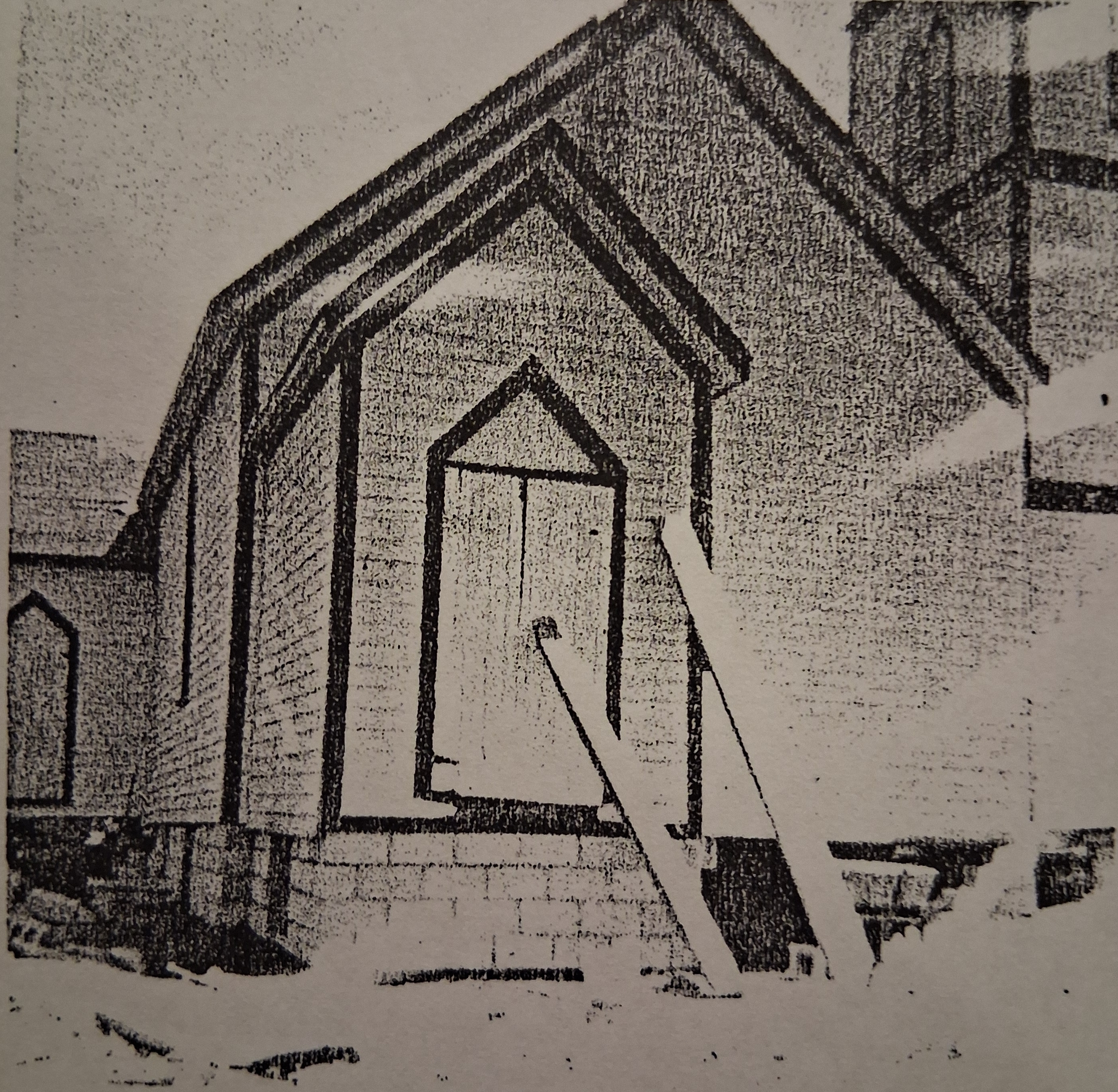
St. Mark's Church Bell
St. Mark's Church Bell is one of the joy of this parish and is said to be one of the finest in the Diocese. The first mention of the bell was at the Annual Easter Vestry meeting on April 15, 1895 when it was decided to order it at once and a day was set for getting the timbere for the tower.
The bell was purchased from the Meneely Bell Company and cost approximately 250.00. It stands 35 inches high and has a diameter of 37 inches and weighs a little over one half ton.
It was once used as the town fire bell and it is said that it can be heard in the town of Kearney nearly five miles away.
The Inscription Reads
May 1895
Right Rev. Edward Slilivan D.D. Bishop of Algona
Rev. Alfred W.H. Chowne B.D. Incumbent of Emsdale
W.E. Streatfield & Wm. Slorach Church wardens
" Non Clamor 8.4.D. Amor Cantant "
other side
Meneely Bell Company
Troy N.Y. U.S.A.
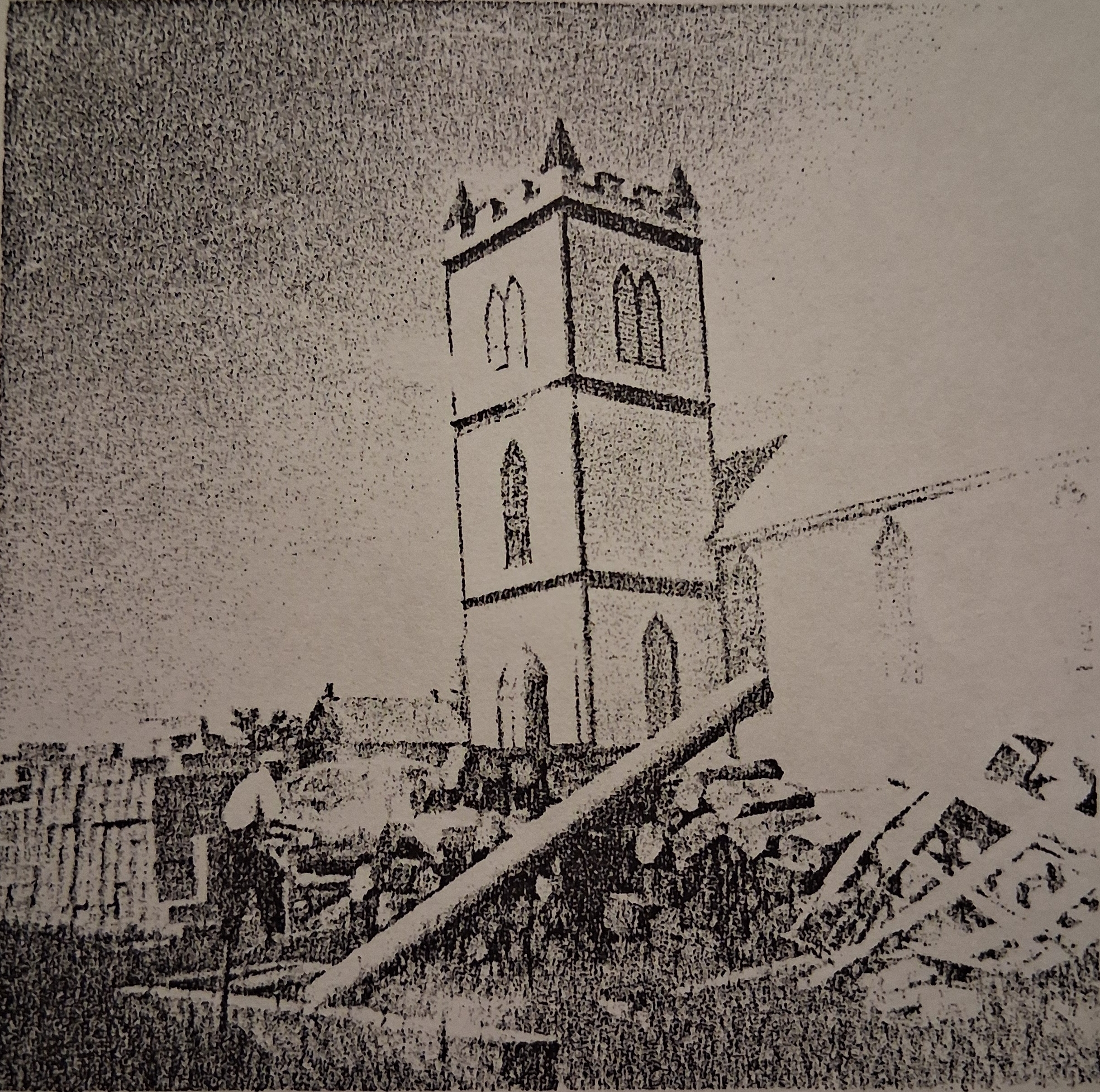
On Good Friday in 1915 said to be the day of the big wind, the bell tower was twisted on its foundation and nearly fell down.
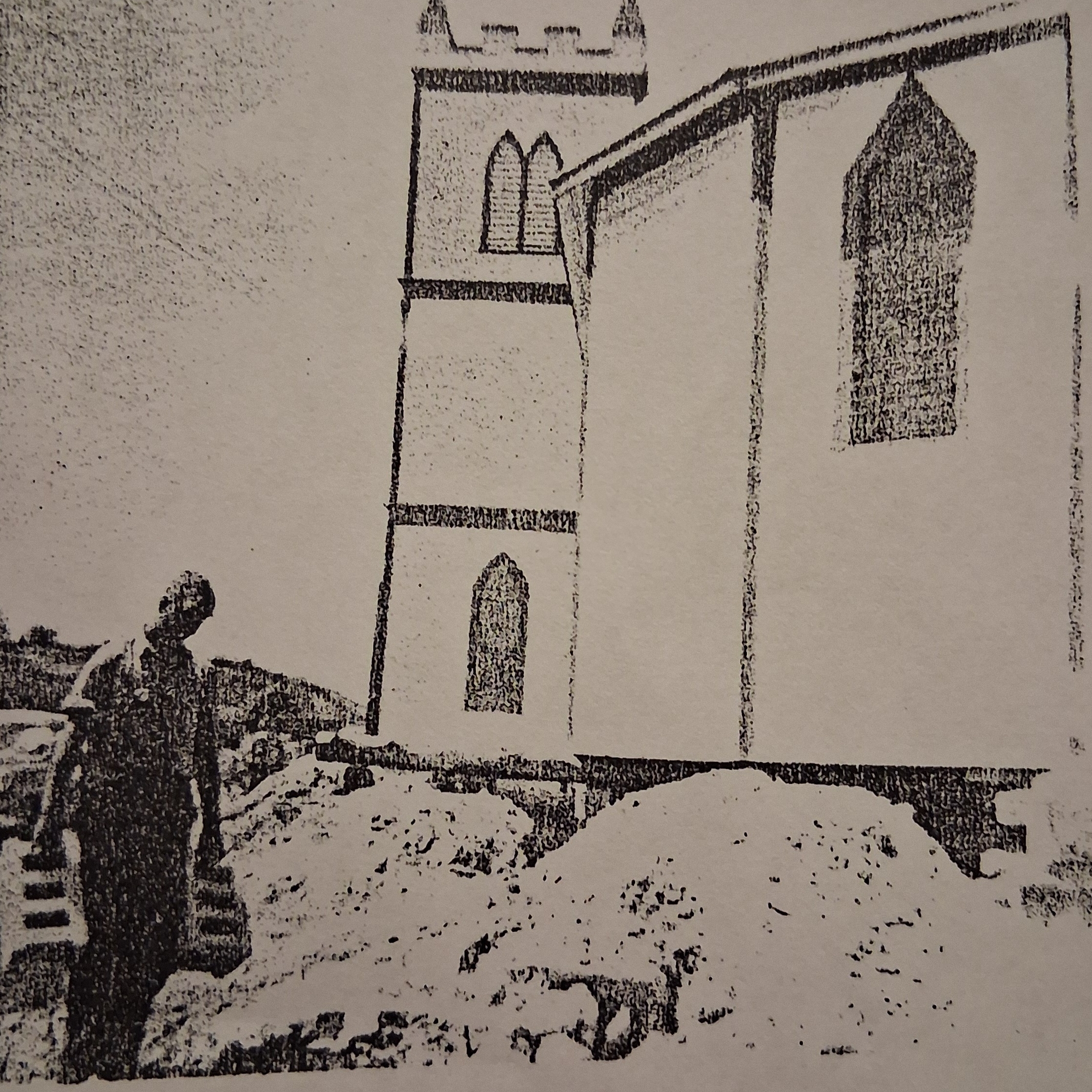
During the summer of 1926 the first bell tower was torn down and replaced with the present one. Those who remember the old bell tower recollect that it commenced at the bottom the same size as at present and gradually tapered to about half the size at the top and had a pointed roof. It had no embellishment of any kind and was really a most uncouth looking affair stuck on the side of a church.
The present tower was patterned after the one at St. Lukės Pro Cathedral in 1985 at Salit Ste. Marie. It was rebuilt by Mr. Aurther Brockington and son George.
St. Mark's Church 100th Anniversary
St. Mark's Church celebrated its 100th anniversary on August 15, 1982.
The event began with a service of Holy Communion in the church. The Rev. Cyril Brazill father of Rev. Rodney Brazill was guest minister and assisted his son with the Holy mcharist and preached the sermon.
The service was followed by a time of fellowship and luncheon at the Emsdale Community Centre. It was a time of great pleasure as many former parishioners, families of form -er clergy and friends gathered together to talk over old times and renew acquaintances. Ifere was also scrap books, news paper clippings, pictures of former clergy and people on display.
St. Mark's was fortunate to have the Junior Choir from St. Athanasius Church in Orillia and their leaders Mr. and Mrs. Gordon Launchbury. The organist Mrs. Elsie Chamberlain was also there. They had been holidaying in Sprucedale and after singing in St. Pali's Church Sprucedale joined us for lunch and sang some of their favourite selections for us. Some of the out of town guests were Ralph and Betty Hayward, Grace (Hayward) Johnston of Islington, Edith (Hayward) Shaw of North Bay, Frank and Marie Hayward of Richmond Hill, Paliine and Jack Mathews of Parry Sound, she is the daughter of the late Canon Simpson.
Mr. and Mrs. Melure of Parry Sound presented a framed picture of St. Mark's Church and the Rectory dated 1910. It was enlarged from a post card.
A beautiflily decorated cake was made for the occasion by Mrs. Rose Patton and enjoyed by all.
The A.0.W. had plates made to sell with a picture of the church on them commemorating the anniversary.
St. Mark's Anglican Church
The first youre of the history of St. Mark'e Charah are not very clear due to the fact that for the first ten years &t formed pebt of the mission of All Saints Church in Burks Pallo, On June 20, 1908 most of the town of Harks Palla Ancluding All Bliate Church was doctroyed by firs. As a reslit St. Mark's Church records were burned also. Prior to the building of St. Mark'a Church services were held in the home of Mrs. Hilliar.
Our mission was a new creation being formed out of the mission of Burks Falls and Ilfracombe. The mission at that time bad Raedale on its contre with Ebberston, Novar, Sprucedale and Katrine as ont postt.
St. Mark's Church first stood on a small triangliar piece of land at the top of the hill out a half mile:deld west of the present village of Rmadale. The property was purchased from Mr. John O. Scarlett on March 11, 1881.
The firet service hold in the church was a Thanksgiving eervice in October of 1881. The first wedding was on April 26, 1882 when Wm. Slorach and amma Oolloneon wore united in Holy Matrimony. The church was consecrated on January 27 1986 by Bishop Edward Slilivan.
In 1886 the Grand Trunk Rellway was opened through from Gravenhurot to North Bay so the town of Godale which wee aleo sitnated on the hill moved to its present alto, but St. Mark's Church remained on the hill for another eight goare.
Rer. W.H. Chowne Rural Dean moved from Rosseau and took charge of the mission at Easter in 1890 at which time only the church and land for the parsonage was provided. The property for the paraonage was a 0lobo or grant of land from the crown. With no house available the first thing to do was to build a parsonage. The members of the church with much d zeal and energy set to work and in December 1890 the building wea advanced enough for occupation.
The original church property where Amadele now stends geous to have been the whole block commencing at the corner of Church and 211zaboth Sta.. month Along Elizabeth St. to what was the telephone office and now a Bell Telephone building, along the north boundary of the telephone company property to the fence behind the parsonage, then north to Church at. and then east along Charoh St. to the corner whore the Nemett residence now stands.
Where St. Mark's Church now stands was previonely the burying ground. In 1892 an acre of land was purchased fromt James Glendenning to he used as the church cemetary. The old cemetary was to be fenced to separate it from the parsonage, but no effort was to be made to move the graves as the expense wolid be too great.
At the annual vestry meeting March 26, 1894 it was found that the debts of the church had become more than colid be paid and the wardens were instructed to contact the Bishop re selling all the land between the graves and the concession line, the proceeds to be used to pay off the outstanding debts.
A special vestry meeting hold June 2, 1994 with the Bishop present, we find that kind friends in England had sent to his Lordship sufficient money to pay off all the debts of St. Mark's Church. It was therefore decided to divide the church property north of the graves into sub lots and sell them, the proceeds to be used exclusively for the purpose of moving the church down from the hill to its present site.
At a special meeting sixteen days later it was decided to divide the property north of the church into four lots of and advertise them in the Toronto Daily Mail. Mr. Wm. 5881 Slorach was to have them surveyed. Another meeting twenty two days later we find that two lots had been sold for $ 200.00, also a cheque had been received from Rev. C.W. Sheatfield in England for $136.26 toward church expenses, and steps were taken towards moving the church.
Mr. Hoover was engaged to build the stone foundation for $ 35.00 and Mr. Chas. Bevan undertook to dig the trench for $ 5.00. At the annual Easter Vestry meeting held April 15, 1895 Mr. W.E. Streatfield, clergymans warden gave an account of all monies expended in moving the church, stone foundation etc. amounted to $ 501.90 which was considered es very sarisfactory.
The first mention of the church bell was made at this meeting when it was decided to order it at once and a day was set for getting the timbers for the tower.
Every thing seems to have gone along smoothly until April 1899 when Rev. A. Chowne caught a cold in the perform- ance of his duties. He was unable to throw it off and died of complications before the end of the month. It is stated that he was here less than nine years yet tales of his good- ness and the grandeur of character are still remembered and spoken of with fond gratitude by those who were privileged to know him. He was buried in St. Mark's Cemetery.
In August 1899 Rev. A.H. Allman was appointed as rector of this mission. At a vestry meeting it was decided a sexton was needed for the purpose of regularity in bell ringing and lighting of lamps etc. and the wardens were impowered to offer $ 1.00 per month as salary.